Kamis, 31 Oktober 2013

Android for all and the new Nexus 5

Just in time for Halloween, we have two new treats for Android fans. First, we're excited to unwrap our latest platform release, KitKat, which delivers a smarter, more immersive Android experience to even more people. And second, we're introducing Nexus 5�a new Nexus phone developed with LG.

The first thing you�ll notice about KitKat is we�ve made the experience much more engaging: the book you're reading, the game you're playing, or the movie you're watching�now all of these take center stage with the new immersive mode, which automatically hides everything except what you really want to see.

Bringing more Google smarts to Android 
Behind the polish on the screen is the power under the hood. Take the Phone app, which for most people hasn�t really changed since the days of flip phones. Now, we�re making calling easier than ever, by helping you search across your contacts, nearby places, or even Google Apps accounts (like your company�s directory), directly from within the app. And with the new Hangouts app, all of your SMS and MMS messages are together in the same place, alongside your other conversations and video calls, so you�ll never miss a message no matter how your friends send it. This is just a small taste of KitKat�learn more on our site.

Google has always focused on helping users get immediate access to the information they need, and we want to bring this same convenience and power to users on Android. With the new Nexus 5 launcher, Google smarts are deeply integrated into the phone you carry around with you, so getting to the information you need is simple, easy and fast. Swipe once from the home screen to get Google Now literally at your fingertips. Put Google to work for you by saying �OK, Google� to launch voice search, send a text, get directions or even play a song you want to hear. And in the coming weeks, we�re enhancing Now with important new card types that bring you information about contextual topics that interest you such as updates from a favorite website or blog.

Reaching the next 1 billion users 
Building a platform that makes mobile phones accessible for everyone has always been at the heart of Android. Until now, some lower-end Android phones couldn't benefit from more recent Android releases due to memory constraints. With KitKat, we've slimmed down Android�s memory footprint by doing things like removing unnecessary background services and reducing the memory consumption of features that you use all the time. We did this not only within Android but across Google services like Chrome and YouTube. RAM (or memory) is one of the most expensive parts of a phone, and now Android can run comfortably on the 512MB of RAM devices that are popular in much of the world, bringing the latest goodies in Android 4.4 within reach for the next billion smartphone users.

Introducing Nexus 5 
Along with our sweet naming tradition, we also introduce a new device with each platform release to showcase the latest Android innovations. For KitKat, we partnered with LG to develop Nexus 5 -- the slimmest and fastest Nexus phone ever made. Its design is simple and refined to showcase the 5� Full HD display. Nexus 5 also keeps you connected at blazing speeds with 4G/LTE and ultra fast wifi. The advanced new lens on Nexus 5 captures more light for brighter night and sharper action shots. And with optical image stabilization, you no longer have to worry about shaky hands and blurry pictures. A new HDR+ mode automatically snaps a rapid burst of photos and combines them to give you the best possible single shot. Learn more on our site.


Nexus 5 is available today, unlocked and without a contract, on Google Play in the U.S., Canada, U.K., Australia, France, Germany, Spain, Italy, Japan and Korea (and coming soon to India), starting at $349. Just in the time for the holidays, Nexus 5 will be available soon at the following retailers: Sprint, T-Mobile, Amazon, Best Buy and RadioShack.

Android 4.4, KitKat, which comes on Nexus 5, will also soon be available on Nexus 4, 7, 10, the Samsung Galaxy S4 and HTC One Google Play edition devices in the coming weeks.

How�s that for a treat?

Posted by Sundar Pichai, SVP, Android, Chrome & Apps

Jumat, 04 Oktober 2013

Tesla Valuation

I don't understand Tesla's stock price and valuation. TSLA is trading at about $175/share right now, with a market cap of $21 billion.

So the market is valuing Tesla at about half the value of GM ($52B), and 1.5x the value of Porsche ($13B)

Based on what?

Tesla is emphatically not Apple. Apple rose to become a top 3 player in mobile phones, the top player in tablet computers, and the top player in MP3 gadgets. Apple sells millions of units, and makes money on hardware, software, service, and content.

Tesla has to make money selling cars--a very highly regulated, capital intensive business. Tesla isn't able to sell direct to consumers in all states of the U.S.

Let's compare Tesla to Porsche.

2013 Sales (1st 2 quarters)
Porsche 81,000
Tesla: ~10,000

2013 Revenue:
Porsche: ~$10 billion
Tesla: ~$1 billion

The stock buyers apparently think that Tesla is a growth company, and are pricing in the expectation that it will grow to something quite a bit more profitable than Porsche. In 2012, Porsche recorded a profit of $2.7 billion. To reach those kinds of results, Tesla has to sell approximately 125,000 cars a year (at $80,000 each) if they are making a similar margin to Porsche. If Tesla goes down to an average price of $50,000/car, they have to sell about 200,000 cars/year.

That's about 8x their current capacity of 500 cars / week (25,000/year).

So, the market seems to think that within a few years, Tesla will be able to open several new plants, and successfully increase their sales and distribution network to rival Porsche, while moving downmarket enough to drive higher volumes.

I am doubtful.

Minggu, 01 September 2013

EU Proposes Satellite Based Speed Limiters

A great demonstration of how the Europeans are not necessarily worth emulating. The EU has proposed ISA (intelligent speed adaptation) based on GPS or sign reading cameras, which would first warn a driver and then automatically slow a vehicle down, if they were exceeding local speed limits.

The scheme would work either using satellites, which would communicate limits to cars automatically, or using cameras to read road signs. Drivers can be given a warning of the speed limit, or their speed could be controlled automatically under the new measures.

Something like this would simply be laughed out of Congress in the States. But in Europe, the EU central regulatory agencies have a lot of power, and top-down regulation is a way of life.

Source: Telegraph

Jumat, 30 Agustus 2013

Diesels: Good MPG, Less So Carbon

I have heard man advocates of small diesels moan that we "just don't get it" here in the U.S. and we need to be more European, and somehow encourage light duty diesels.

What the compression ignition lovers don't realize is that the U.S. policy is very much now based around global warming and carbon reduction, whereas it used to be about reducing oil consumption for geopolitical reasons (OPEC etc.)

So, let's look at carbon emissions:

1 gallon of gasoline when burned will emit approximately 19.64 pounds of CO2.
1 gallon of diesel will emit approximately 22.38 pounds of CO2.

Diesel is about 14% more carbon emitting than gasoline.

But, a diesel engine is about 30% more fuel efficient than a similarly sized gasoline engine. So if we do the math, a similarly sized diesel powered car will emit about 14% less CO2 than a similar diesel car. Not bad, but not huge.

Meanwhile, diesel fuel offers no advantage in the U.S. in cost (it is more expensive than gasoline by about 30%), and the vehicles cost more due to the diesel hardware premium.

Senin, 26 Agustus 2013

Tesla's Extra 0.4 Star

Tesla is trumpeting the Model S' excellent performance in NHTSA's safety tests. Tesla says that the model S has achieved a combined rating of "5.4 stars":

Palo Alto, CA � Independent testing by the National Highway Traffic Safety Administration (NHTSA) has awarded the Tesla Model S a 5-star safety rating, not just overall, but in every subcategory without exception. Approximately one percent of all cars tested by the federal government achieve 5 stars across the board. NHTSA does not publish a star rating above 5, however safety levels better than 5 stars are captured in the overall Vehicle Safety Score (VSS) provided to manufacturers, where the Model S achieved a new combined record of 5.4 stars.

This is very odd publicity, to me. NHTSA awards star ratings as integers, and 5 stars is the most you can get. A 5 star rating means that you have less than a 10% chance of serious injury in a serious accident, according to NHTSA's statistical model.

You can't get more than 5 stars, awarded by NHTSA.

Tesla is just trying too hard, here, I think. A 5-star result is excellent, and they should proudly publicize it.

Rabu, 21 Agustus 2013

Here, there and everywhere: Google Keep reminds you at the right time

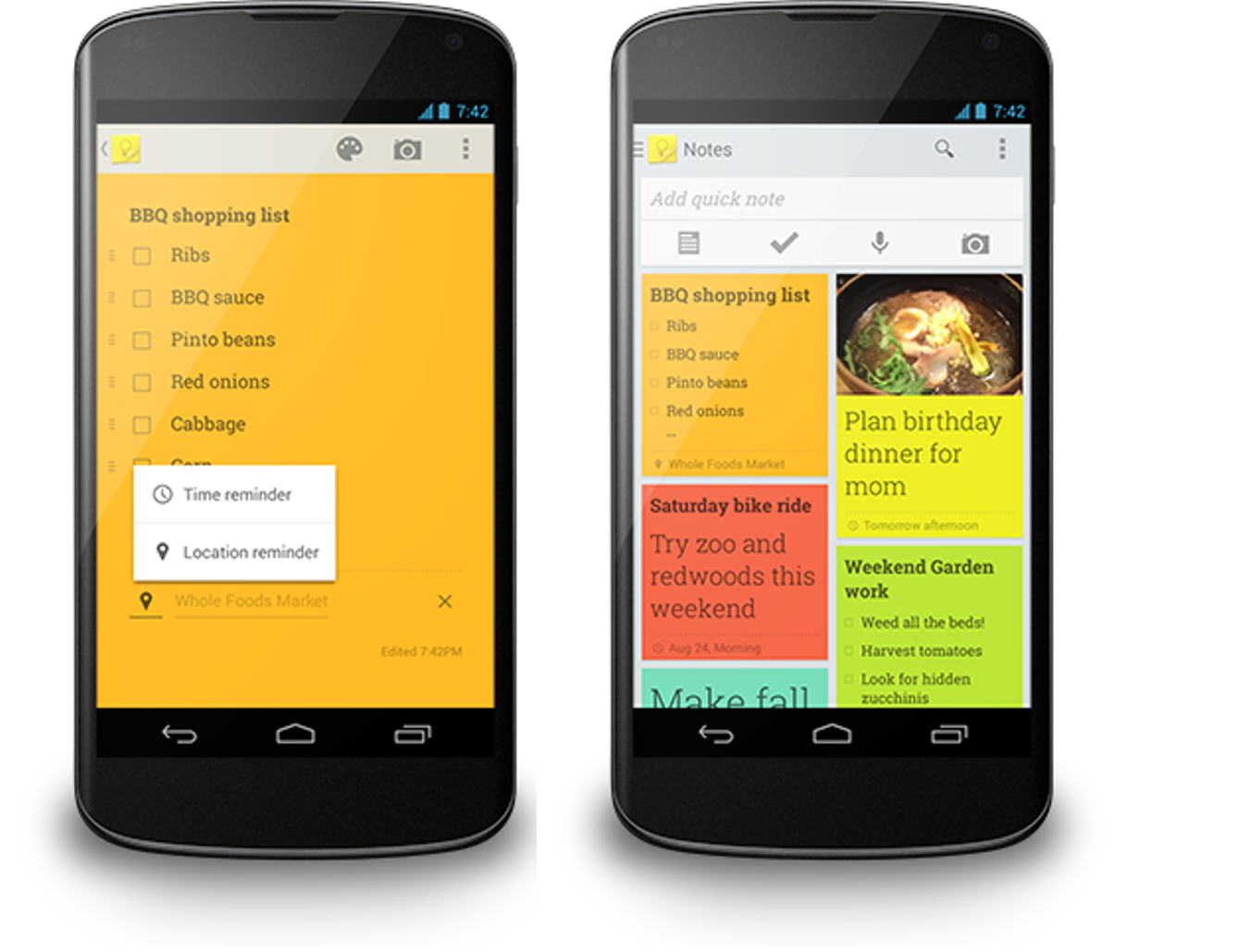
Notes are a good way to keep track of all you have to do, but most of us need a little nudge now and then. Google Keep can remind you of important tasks and errands at just the right time and place. For example, Keep works with Google Now to remind you of your grocery list when you walk into your favorite grocery store, and nudges you on Thursday night to take out the trash.

To get started, select the �Remind me� button from the bottom of any note and choose the type of reminder you want to add. You can add time-based reminders for a specific date and time, or a more general time of day, like tomorrow morning. Adding a location reminder is incredibly easy too�as soon as you start typing Google Keep suggests places nearby.


 ?
Of course, sometimes plans change. If you get a reminder you�re not ready to deal with, simply snooze it to a time or place that�s better for you.


It�s now even easier to get to all of your notes using the new navigation drawer, which includes a way to view all of your upcoming reminders in one place. And for people who want more separation between their home and work lives, the drawer also lets you easily switch between your accounts. 


And finally, we've made it easier to add your existing photos to a Google Keep note on Android. When you tap the camera icon you can choose between taking a new photo or adding one you already have from Gallery.

The new update is gradually rolling out in Google Play, and available now on the web at http://drive.google.com/keep and in the Chrome App.


Posted by Erin Rosenthal, Product Manager

Jumat, 16 Agustus 2013

Ford's C-Max Debacle Explained

Ford yesterday announced that it was re-stating the fuel economy label of the C-Max hybrid, from 47 city / 47 highway /47 combined to a still very good but not as impressive 45city / 40highway / 43combined. Note the large decline in the highway number.

So what happened? Did Ford cheat the test? Not really.

What happened was that Ford used the Fusion Hybrid test results to certify the C-Max, which they are allowed to do according to EPA regulations. The EPA regs allow manufacturers to certify vehicles as a group if they are in the same weight class and share powertrains.

Here is the EPA's short report on the matter. An excerpt:

Ford based the 2013 Ford C-Max label on testing of the related Ford Fusion hybrid, which has the same engine, transmission and test weight as allowed under EPA regulations. For the vast majority of vehicles this approach would have yielded an appropriate label value for the car, but these new vehicles are more sensitive to small design differences than conventional vehicles because advanced highly efficient vehicles use so little fuel.

In this case, EPA's evaluation found that the C-Max's aerodynamic characteristics resulted in a significant difference in fuel economy from the Fusion hybrid.

Was this intentional, a case of Ford using the higher number for marketing purposes? Or was it a case of simply not knowing that the C-Max would test out so much differently? I have no idea. But I think in the future, Ford and other carmakers are going to be more careful about publishing fuel economy numbers based on assumptions, after this PR disaster.